

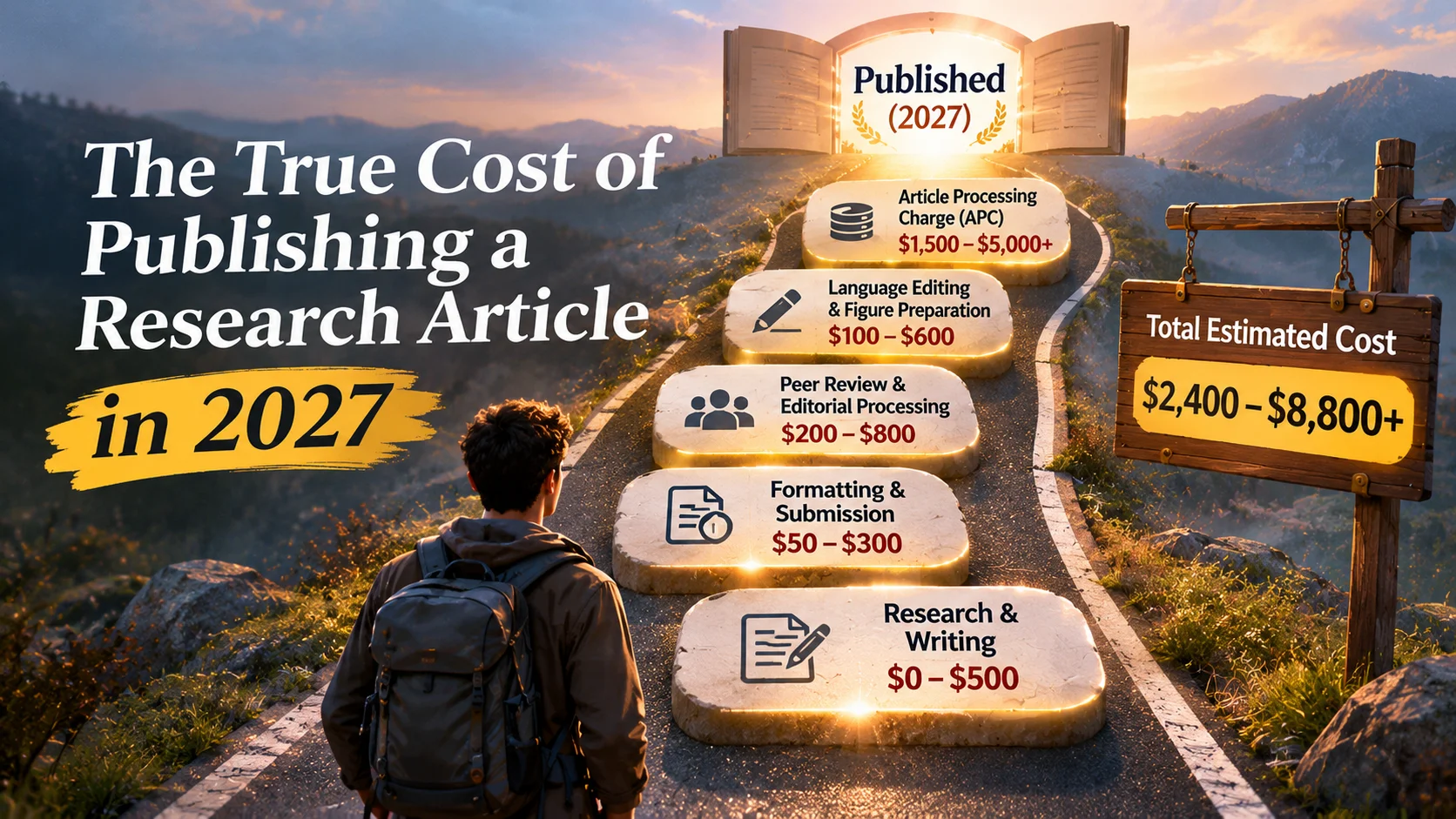
When an academic journal charges an author to publish a research article, a frequently asked question is how much it actually costs the publisher to produce that article.
The question appears straightforward, but the answer is rarely simple.
An article published on a journal website represents the final output of a process that may involve several months of editorial administration, peer review, revision, production and quality assurance.
The financial cost of this process varies considerably between publications.
As publishers prepare for 2027, understanding the economics behind scholarly communication is becoming increasingly important for authors, institutions and journal owners.
The Difference Between Cost and Price
An article processing charge, commonly known as an APC, is the price associated with publishing an article under a particular business model.
It is not necessarily a direct calculation of the expenditure required to produce that specific article.
Publishers may use publication revenue to support rejected manuscript processing, technology infrastructure, administrative staff, journal development and long-term preservation.
Commercial publishers may also include a profit margin, while nonprofit organisations may allocate surpluses towards their wider academic activities.
Understanding publishing economics therefore requires distinguishing direct production costs from the total cost of maintaining a publication.
Editorial Management
The publishing process begins before a manuscript reaches peer review.
Editorial teams must check submissions for completeness, suitability, ethical declarations, originality and compliance with journal requirements.
Some manuscripts are rejected at this stage. Others require substantial administrative coordination before reviewers can be assigned.
These activities create costs regardless of whether the manuscript is ultimately published.
A journal with a high rejection rate may therefore incur considerable editorial expenditure for every article it accepts.
Peer Review and Specialist Assessment
Managing peer review involves identifying suitable experts, sending invitations, monitoring responses, coordinating revisions and supporting editorial decisions.
Although reviewers often contribute their expertise voluntarily, administrative management still requires staff time and technological infrastructure.
Some manuscripts may also require specialist statistical assessment, methodological evaluation or additional research integrity checks.
The cost of these services depends on the complexity of the research and the journal's quality assurance requirements.
Production and Publication
Once a manuscript is accepted, it enters the production process.
Depending on the publisher, this may include:
- Copy-editing.
- Language editing.
- Typesetting.
- Figure and table preparation.
- Reference formatting.
- Author proof management.
- PDF and HTML generation.
- XML conversion.
- Metadata preparation.
- DOI registration.
- Publication and distribution.
The level of editorial and production support offered to authors varies substantially between journals.
A publication providing extensive professional editing may incur higher costs than one relying heavily on author-prepared manuscripts and automated production systems.
Digital Infrastructure and Permanent Accessibility
Publishing does not end when an article appears online.
Publishers must maintain websites, protect information systems, preserve scholarly content and ensure that persistent identifiers continue directing readers to the correct publications.
Crossref membership and content registration are examples of infrastructure-related expenditure.
However, the direct registration cost of a DOI represents only a small component of the wider publishing process.
Reliable hosting, metadata maintenance, backup systems, digital preservation and technical support must also be considered.
See Crossref's published fee schedule.
Research Integrity and Post-Publication Responsibilities
Publishers must be prepared to investigate concerns involving research misconduct, unreliable results and ethical violations.
Such investigations may require extensive communication with authors, reviewers, academic institutions and specialist advisers.
Corrections, expressions of concern and retractions create additional responsibilities.
These obligations continue after publication and should form part of a journal's operational budget.
A publisher that fails to account for research integrity costs may underestimate the true financial requirements of maintaining a credible scholarly publication.
What Does Existing Research Suggest?
A 2021 study by Alexander Grossmann and Björn Brembs examined market rates for different scholarly publishing services.
The study found substantial variation in estimated publishing costs depending on the operational model, scale and rejection rate.
These historical estimates remain useful for understanding cost structures, but they should not be treated as universal or current 2027 market prices.
Technology costs, labour expenses, service requirements and inflation can change considerably over time.
Read the study on scholarly publishing service costs.
An Illustrative Publishing Cost Model
Consider a hypothetical independent journal receiving 400 submissions and publishing 100 articles annually.
Assume the following annual operating expenditure:
- Editorial administration: USD 30,000.
- Production and typesetting: USD 15,000.
- Hosting and publishing software: USD 8,000.
- Research integrity and specialist checks: USD 7,000.
- Metadata, registration and preservation: USD 3,000.
- Author support and administration: USD 7,000.
- Legal, marketing and general overheads: USD 10,000.
The total illustrative annual expenditure would be USD 80,000.
With 100 published articles, the average operating cost would be USD 800 per published article.
This is a hypothetical calculation, not an industry average or a forecast of actual 2027 prices.
It also demonstrates why lower publication volumes can produce higher average costs when substantial fixed expenses remain unchanged.
Can Artificial Intelligence Reduce Publishing Costs?
Automation may improve efficiency in manuscript screening, reference checks, formatting, metadata preparation and editorial administration.
However, introducing artificial intelligence also requires investment in secure systems, validation, monitoring and professional oversight.
Poorly implemented automation can create additional costs through errors and unnecessary corrections.
The commercial benefit therefore depends on whether the technology produces reliable improvements in the overall publishing workflow.
Conclusion
There is no single correct cost for publishing a research article.
A credible assessment must account for the journal's scale, service quality, rejection rate, infrastructure requirements and long-term responsibilities.
As the industry approaches 2027, greater transparency around publishing expenditure could help researchers and institutions evaluate whether publication charges represent appropriate value.
The objective should not be to publish research at the lowest possible cost.
It should be to maintain reliable scholarly communication at a financially sustainable and proportionate cost.
Further Reading
Current Market Rates for Scholarly Publishing Services
Crossref Membership and Registration Fees
Principles of Transparency and Best Practice in Scholarly Publishing