

If 2024 and 2025 were the years scholarly publishers debated what generative AI might do to peer review, 2026 has been the year those concerns materialised in editorial workflows, prompting calls for structural changes across the industry.
As 2026 approaches its conclusion, four major themes have emerged from policy developments, editorial disputes and post-publication investigations.
Adversarial AI Tactics Entered the Peer-Review Pipeline
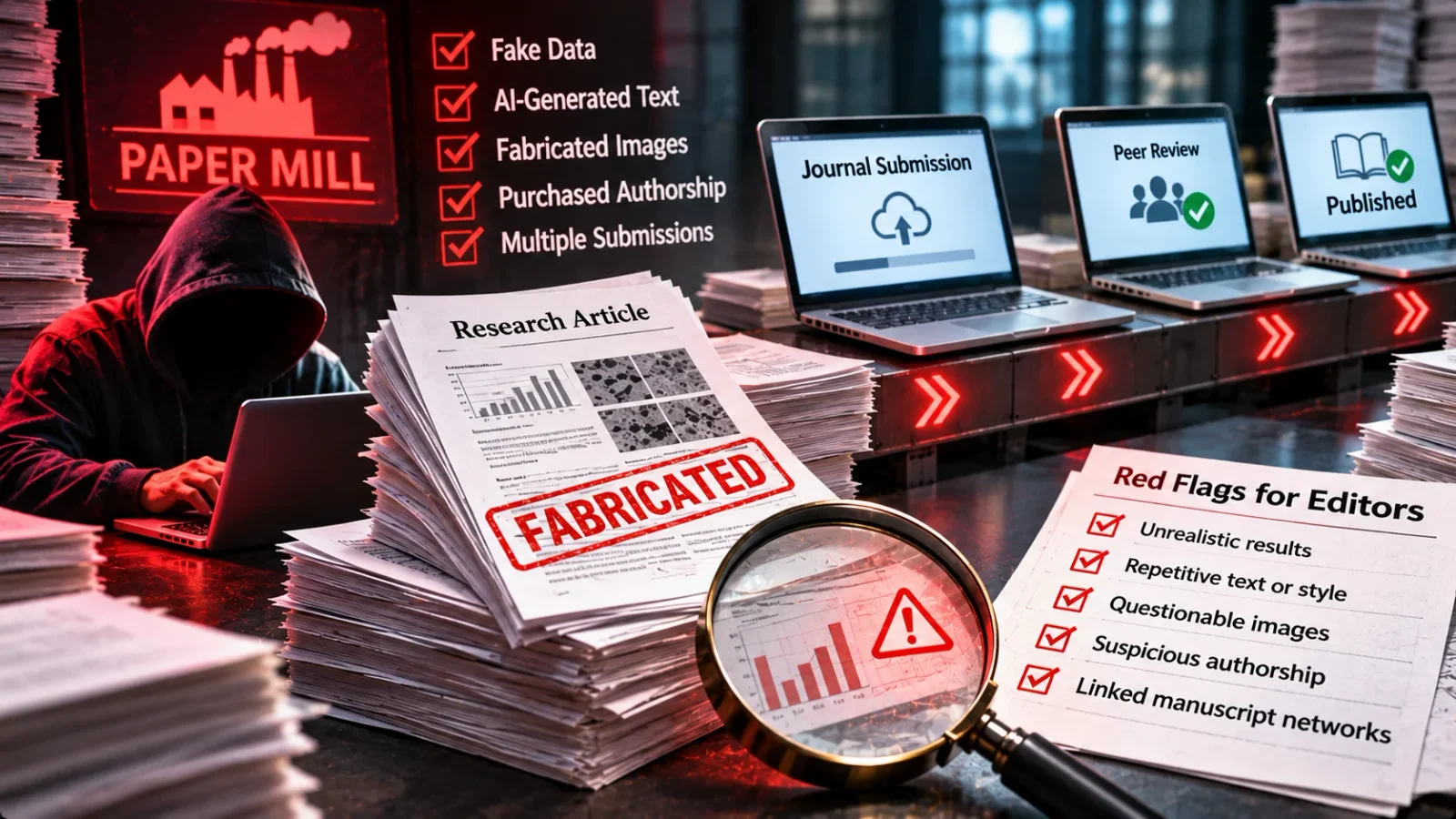
This year marked an escalation in attempts to manipulate automated manuscript screening and AI-assisted peer review.
In November, Taylor & Francis reportedly retracted a biomedical engineering paper after investigators identified hidden prompt-injection text embedded within the published manuscript. These instructions were reportedly inserted during revision to influence AI-assisted peer reviewers into returning favourable evaluations.
Meanwhile, Elsevier and IEEE reportedly launched investigations into more than a dozen artificial intelligence studies claiming to predict blood types from fingerprints, after the underlying datasets were traced to a public biometric repository.
These developments highlight an emerging challenge for publishers: protecting editorial workflows against deliberate manipulation while continuing to benefit from advances in artificial intelligence.
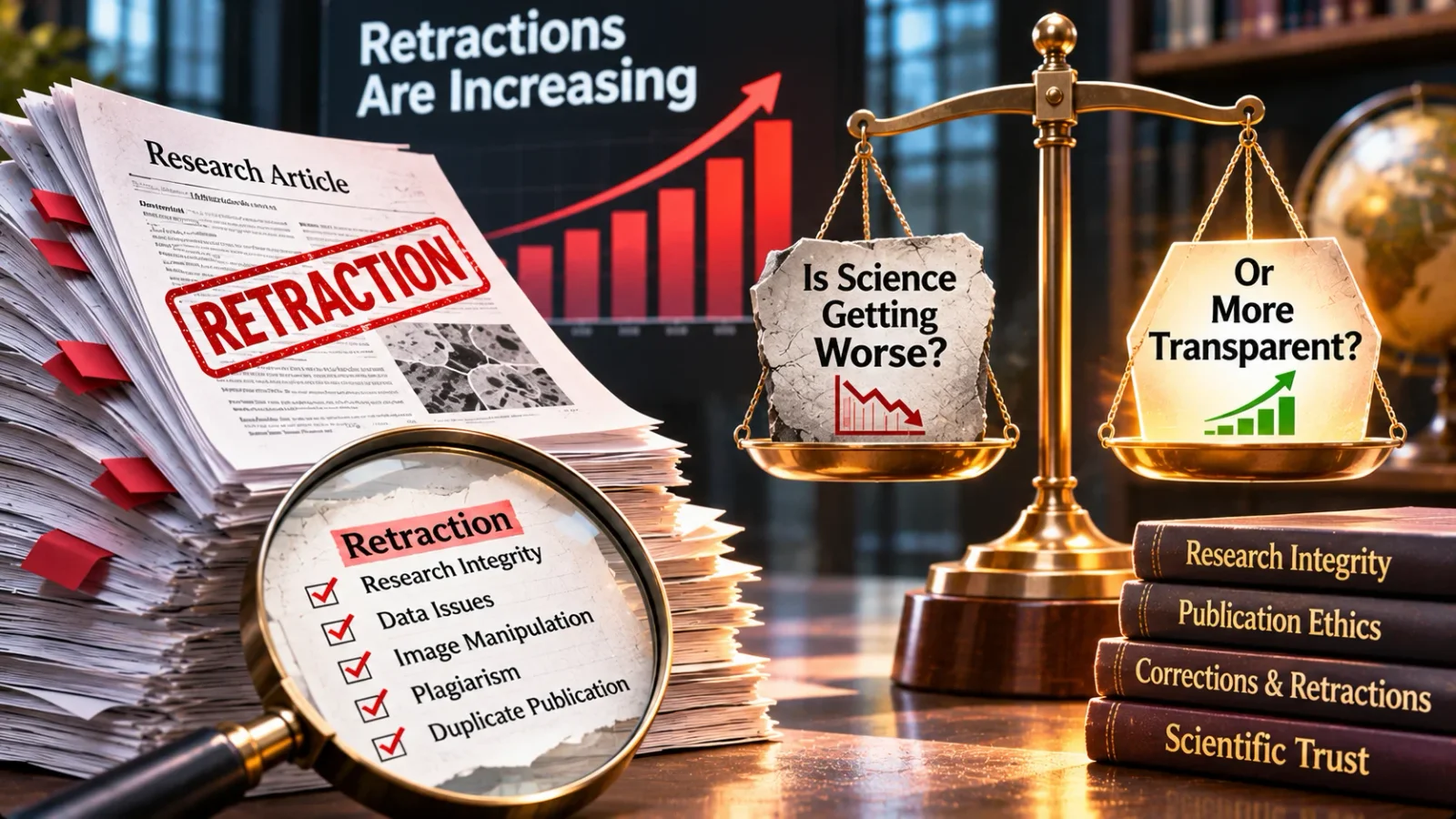
A Growing Push for Faster Retractions and Raw Data Retention
For years, research integrity advocates have raised concerns about the time required to investigate and retract unreliable scientific publications.
In November 2026, a report attributed to the U.S. National Academies of Sciences, Engineering, and Medicine reportedly recommended completing standard research integrity assessments within 12 weeks, with a six-month ceiling for complex institutional investigations.
The report also reportedly recommended treating an author's inability to provide original raw research data as grounds for retraction.
These recommendations come amid reports of more than 200 published papers containing impossible protein signals in gene-null cells, alongside continuing retractions associated with the research of former NIH neuroscientist Eliezer Masliah.
The developments underscore the importance of raw data preservation, research reproducibility and timely correction of the scientific record.
Citation Hallucinations Caught Editorial Boards Off Guard
AI-generated reference errors have emerged as a significant concern, affecting not only submitted research manuscripts but also editorial commentary.
Earlier in November, Taylor & Francis reportedly retracted an editorial co-authored by editors of the Journal of Further and Higher Education after readers identified multiple fabricated citations.
The incident highlights a broader vulnerability in scholarly publishing: commissioned editorials and other front-matter require the same level of reference verification as original research articles.
Reference verification is increasingly becoming an essential component of editorial quality control rather than an optional technical safeguard.
Publishers may need to incorporate automated citation validation, DOI verification and bibliographic screening into their standard production workflows.
Editorial Board Friction Over Governance and Review Models
Beyond technological challenges, tensions surrounding editorial independence and publisher governance have surfaced repeatedly.
Editorial walkouts were reported at journals including Critical Public Health and Communications in Algebra. At the latter, 23 of 31 editorial board members reportedly resigned following the removal of the editor-in-chief and changes to traditional peer-review workflows.
These disputes raise important questions about the balance between publisher-led operational changes and the academic independence of editorial boards.
Meanwhile, discussions involving the International Science Council (ISC), the Committee on Publication Ethics (COPE) and STM reflect growing interest in developing consistent approaches to artificial intelligence disclosure and responsible technology adoption.
Together, these developments suggest that editorial governance is entering a period of increased scrutiny and evolving expectations.
What This Means for Academic Publishers
The developments of 2026 indicate that scholarly publishing is undergoing a transformation that extends beyond the adoption of artificial intelligence.
Publishers and editorial boards should increasingly prioritise:
- Detection of hidden prompts and manuscript manipulation.
- Automated citation and reference verification.
- Transparent research integrity investigation timelines.
- Raw data retention and research reproducibility.
- Clear disclosure policies for artificial intelligence usage.
- Protection of editorial independence.
- Stronger post-publication monitoring and correction mechanisms.
The challenge is not simply whether publishers should adopt artificial intelligence, but how they can incorporate it without compromising the credibility, independence and reliability of scholarly communication.
Looking Ahead to 2027
As the industry moves towards 2027, publishers will need to balance technological innovation with established principles of research integrity.
Artificial intelligence presents opportunities to improve editorial efficiency, identify inconsistencies and strengthen manuscript screening. However, its integration must be accompanied by appropriate safeguards, transparent policies and accountable editorial decision-making.
The future of scholarly publishing will depend not only on how quickly publishers adopt new technologies, but also on how effectively they protect the trust upon which scientific communication depends.