

Despite decades of digital transformation, the basic experience of reading an academic journal remains surprisingly familiar.
A researcher discovers an article, opens its landing page, reads the abstract and downloads a PDF.
The process is more convenient than consulting a printed journal in a university library, but the fundamental structure of the scientific publication has remained largely unchanged.
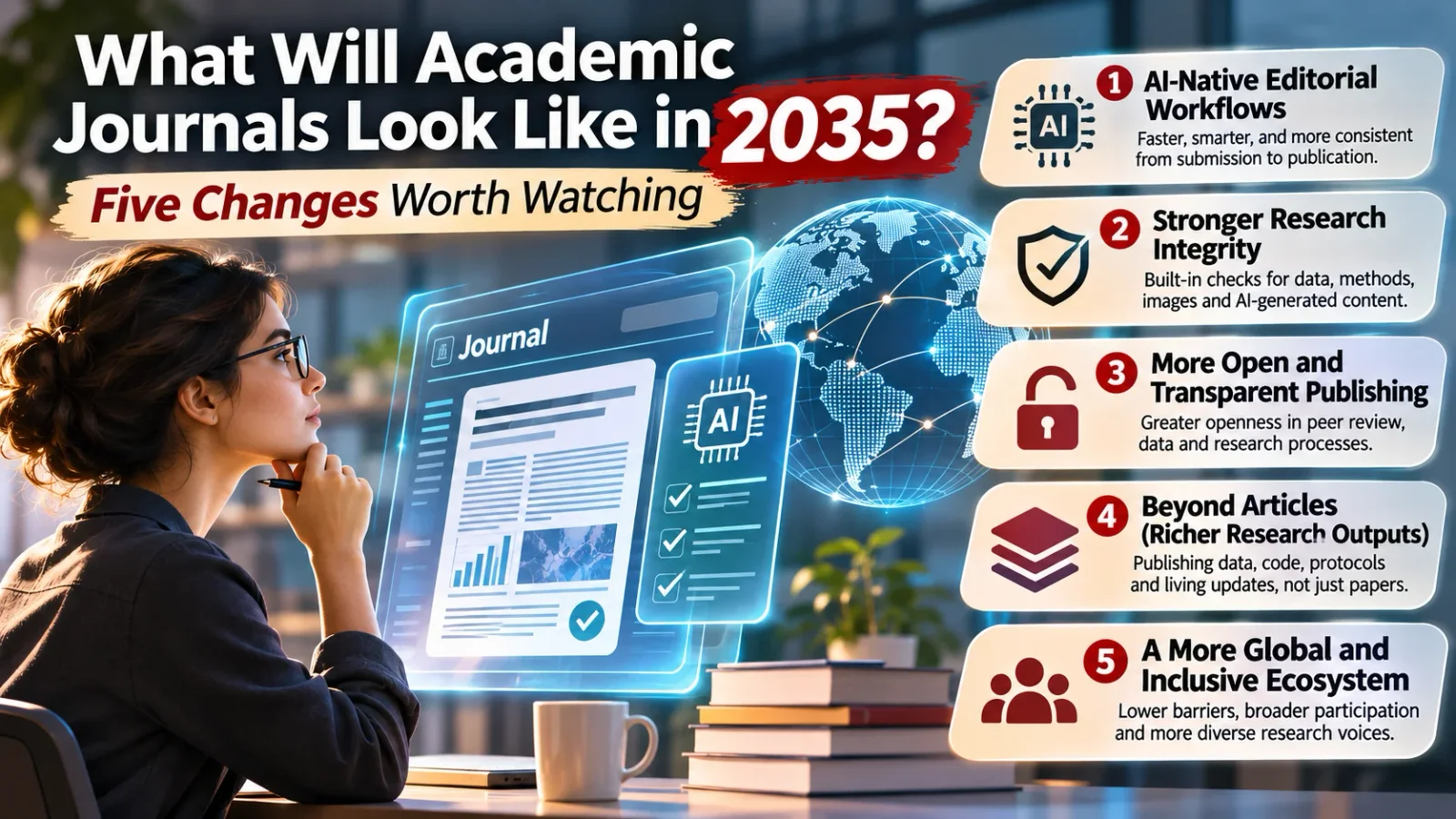
Artificial intelligence, research data infrastructure and emerging digital standards may now challenge this traditional approach.
By 2030, the academic journal could become something more than a collection of published articles.
It may increasingly function as an interconnected research platform.
Moving Beyond the PDF
The PDF has served scholarly publishing well.
It provides a stable, portable and familiar representation of an academic article.
However, its usefulness within intelligent research systems can be limited when information is difficult to extract accurately.
A scientific article contains numerous distinct elements, including methodologies, numerical findings, references, research data, author information and supplementary materials.
Structured publishing makes these components more accessible to both human readers and computational systems.
Machine-readable content could allow researchers to compare methodologies across studies, locate specific experimental findings and identify related datasets more efficiently.
The PDF will probably remain available, but it may become one of several ways to interact with scholarly research.
From Searching Articles to Asking Research Questions
Traditional scholarly search requires researchers to select keywords, examine results and read individual publications.
AI-powered research assistants introduce a different approach.
Researchers can formulate questions and receive structured explanations supported by relevant literature.
A future journal platform may incorporate tools that allow readers to explore its archive through specialised research queries.
A clinical researcher could ask which studies within a journal examined a particular patient population.
An engineering researcher could compare materials or experimental conditions described across several publications.
Such capabilities could make extensive scientific archives considerably more useful.
Nevertheless, these systems must distinguish clearly between verified article content and generated interpretations.
Researchers must also be able to inspect the original sources supporting an answer.
Intelligent Editorial Workflows
The editorial process may also change substantially.
Future manuscript management systems could incorporate more extensive automated checks for reporting completeness, statistical inconsistencies, citation accuracy and potential research integrity concerns.
Editors may receive structured assessments before assigning manuscripts to reviewers.
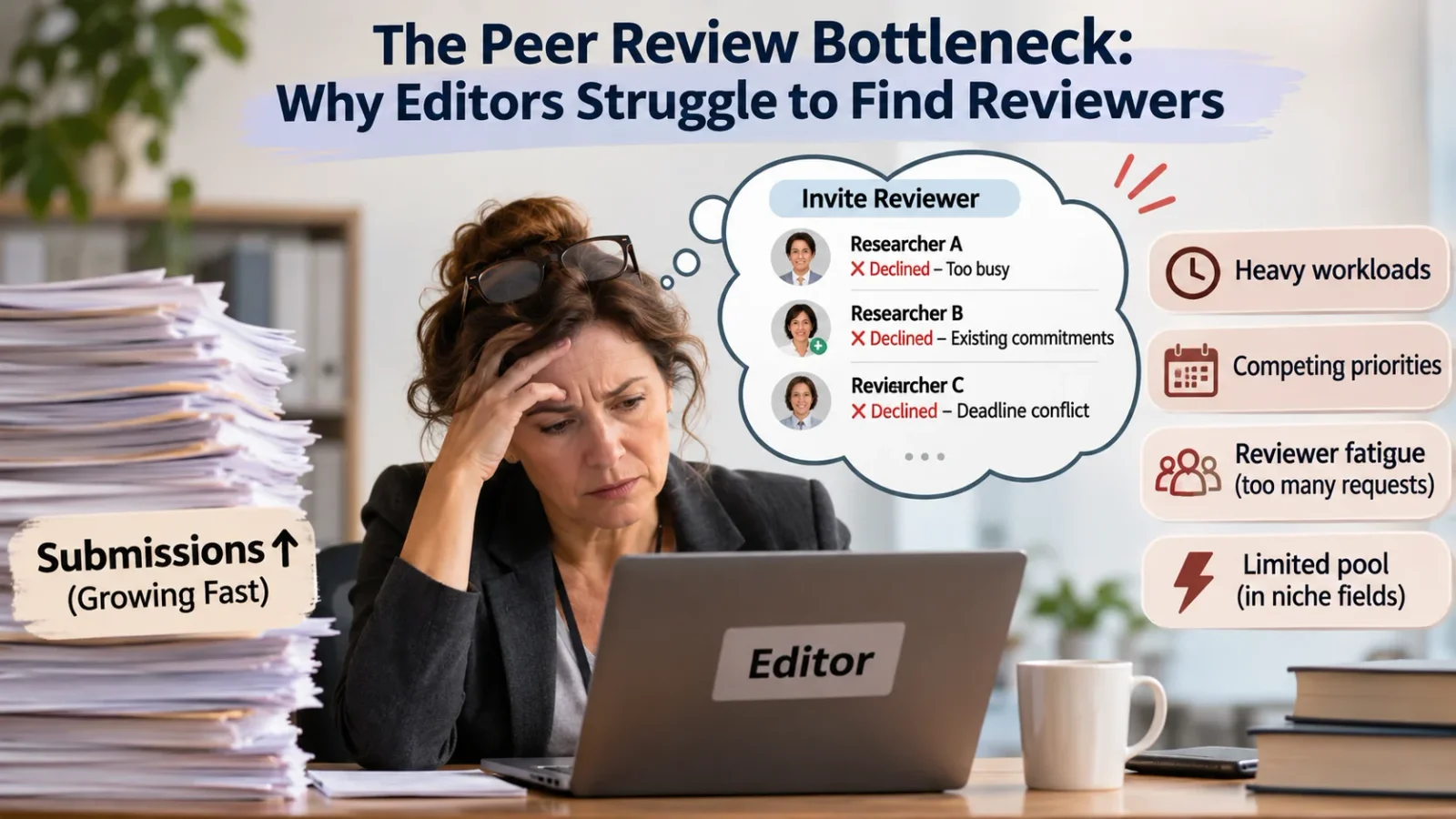
Reviewer selection could become more precise through improved understanding of disciplinary expertise and conflicts of interest.
Administrative tasks such as formatting checks, correspondence and production coordination could become increasingly automated.
The objective should be to reduce repetitive work while allowing editors and reviewers to concentrate on scientific quality and professional judgement.
Automated assessments must remain subject to appropriate validation and oversight.
Research Data as Part of the Publication
Scientific articles are often accompanied by datasets, analytical code, supplementary materials and experimental protocols.
However, these elements may be distributed across different repositories and institutional systems.
A more interconnected journal platform could provide readers with clearer access to the supporting materials associated with a publication.
Researchers may be able to examine datasets, reproduce analytical procedures or compare experimental methods without navigating numerous disconnected systems.
These developments could strengthen research transparency and support reproducibility.
Privacy, consent, security and legal restrictions will remain important, particularly for medical and other sensitive research data.
Not every dataset can or should be openly accessible.
Keeping the Scientific Record Current
A printed scientific article cannot be easily updated after publication.
Digital publishing provides greater flexibility, but maintaining a transparent record of changes remains essential.
Corrections, retractions and expressions of concern must be communicated in ways that preserve the integrity of the original publication.
Crossref's infrastructure already supports structured relationships between articles and subsequent editorial updates.
Future research platforms may be able to communicate these changes more effectively to readers, indexing systems and AI research assistants.
This would reduce the risk of outdated or withdrawn findings being presented without appropriate context.
Read Crossref's guidance on corrections and retractions.
The Changing Role of the Editorial Board
Editorial boards are unlikely to become unnecessary as artificial intelligence develops.
Their responsibilities may instead evolve.
Subject experts will remain important in determining the significance of research, evaluating disciplinary relevance and interpreting complex findings.
Editors may also need to establish policies governing automated manuscript assessment, AI disclosure, data availability and technology-assisted peer review.
Academic leadership will remain essential to ensuring that technological systems serve research communities rather than commercial or purely computational objectives.
New Opportunities for Independent Journals
Smaller publishers may struggle to develop advanced research platforms internally.
However, shared infrastructure could allow independent journals to access capabilities that were previously available primarily to larger publishing companies.
Structured content services, research integrity tools, manuscript automation and shared discovery platforms may become increasingly accessible.
Independent publishers should consider which technologies genuinely improve the experience of authors, reviewers and readers.
A sophisticated platform is not automatically a better platform.
Technology investments should address identifiable operational or scholarly needs.
What Will Publishers Compete On?
Academic publishers have traditionally competed for authors, readership, citations and institutional relationships.
By 2030, competition may also involve the quality of research discovery tools, accessibility of data, integration with external platforms and the reliability of editorial infrastructure.
A publication's archive could become more valuable when it is accurately structured, legally accessible and connected to relevant scientific information.
However, such capabilities should not overshadow the importance of academic credibility.
A technologically advanced journal publishing unreliable research will not provide a sustainable foundation for scholarly communication.
The Journal of 2030
No one can predict precisely how the academic journal will evolve over the next four years.
Some proposed technologies may become widely adopted. Others may fail to deliver sufficient benefits.
Nevertheless, the direction of current developments suggests that scholarly publications will become more connected, structured and responsive to the needs of researchers.
The academic journal may increasingly serve as a trusted source of scientific knowledge within a broader technological ecosystem.
Its fundamental purpose, however, should remain unchanged.
It must provide a credible environment in which research can be evaluated, preserved, discovered and used to advance human understanding.
Further Reading
STM and Ithaka S+R: Research Project on Scholarly Content and AI
Crossref: Version Control, Corrections and Retractions
Ithaka S+R: A Third Transformation?
This article presents a forward-looking industry analysis. Descriptions of potential publishing capabilities in 2030 are projections rather than confirmed developments.