

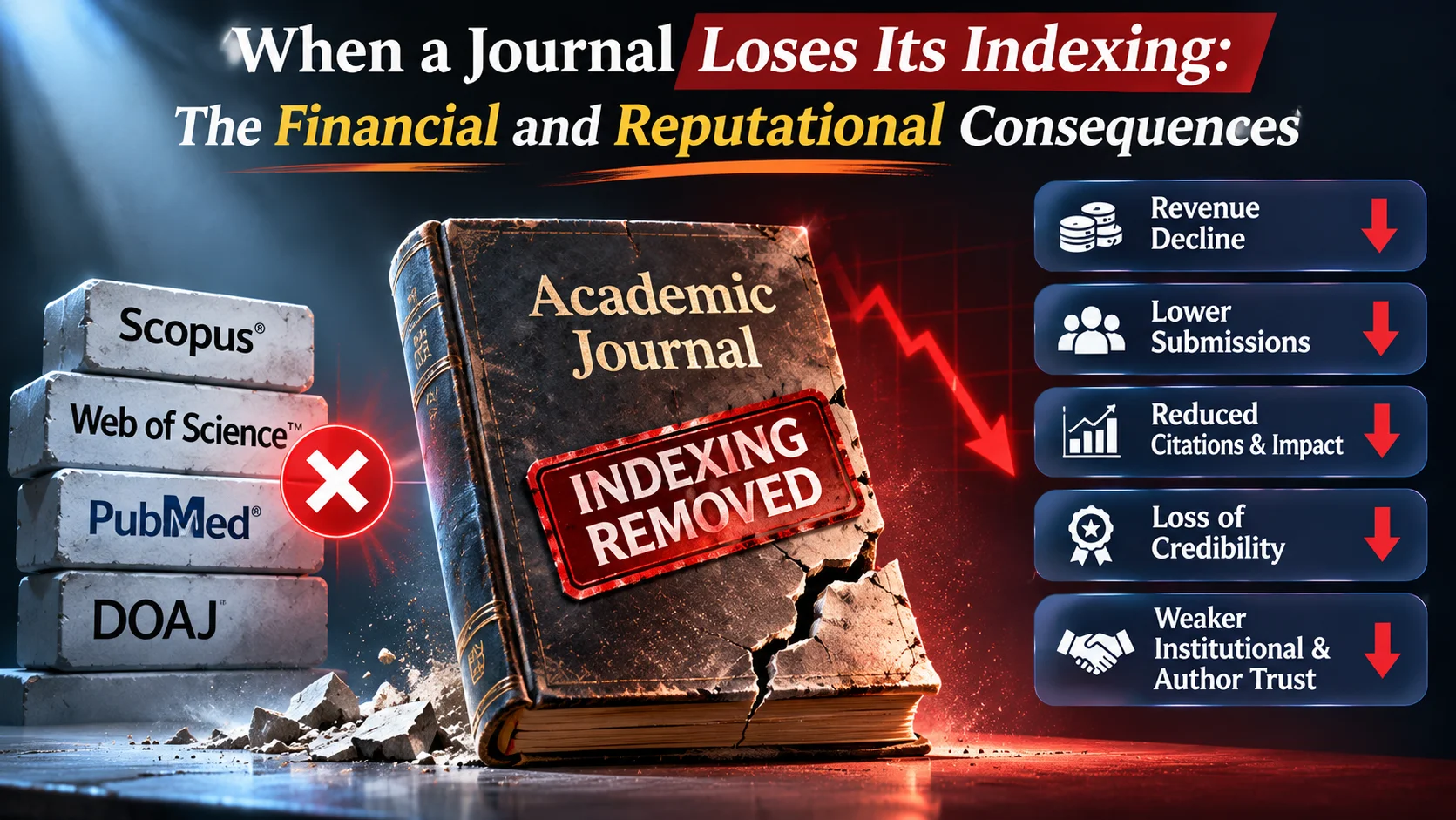
For many academic journals, inclusion in a recognised indexing database represents an important milestone.
It can improve the discoverability of published research, strengthen author confidence and contribute to the visibility of a publication within its academic community.
For some researchers, indexing coverage is also relevant to institutional promotion requirements, doctoral programmes and research funding assessments.
Consequently, when a journal loses its indexing coverage, the consequences may extend well beyond a change in its bibliographic status.
The event can affect the journal's reputation, financial performance and long-term sustainability.
Why Journals Lose Indexing Coverage
Indexing databases maintain their own selection and continuing evaluation procedures.
A journal that has previously been accepted may subsequently undergo reassessment.
Concerns may involve editorial quality, publication regularity, research integrity, citation practices or compliance with the database's requirements.
In some cases, discontinuation may also arise from production-related issues or changes to a publication's operating status.
The reasons and consequences vary according to the indexing organisation and the circumstances of the individual journal.
Publishers should therefore distinguish confirmed findings from assumptions and examine the official explanation before responding.
Discontinuation Does Not Necessarily Remove the Entire Archive
A common misconception is that losing indexing automatically removes all previously published articles from the relevant database.
Scopus states that previously indexed content generally remains part of the scientific record when a journal is discontinued or placed on hold.
Clarivate's policies similarly describe the date from which future content may cease to receive coverage, while also allowing removal of existing content in certain circumstances.
Authors and publishers should verify the precise coverage dates and official status of the journal rather than assuming that every historical article is affected in the same way.
Scopus Content Policy and Selection
Web of Science Master Journal List
The Immediate Effect on Author Confidence
Many researchers consider indexing status when selecting a journal.
An unexpected change may lead prospective authors to reconsider submitting their manuscripts, particularly where their institution requires publication in specific databases.
Authors with manuscripts already under review may request clarification or withdrawal.
Editors and reviewers may also seek information about the circumstances surrounding the decision.
A publisher's response during this period can significantly influence whether the academic community continues to trust the publication.
Transparent communication is essential.
Understanding the Financial Consequences
For journals operating through article processing charges, a decline in submissions may eventually reduce publication revenue.
Consider an illustrative journal publishing 150 articles annually at an average collected publication charge of USD 1,000.
Its annual gross publication revenue would be USD 150,000.
If publication volume declined to 60 articles following a significant reduction in qualified submissions, annual gross revenue would fall to USD 60,000.
That would represent a reduction of USD 90,000, or 60%.
This is a hypothetical scenario rather than a prediction of what happens to every discontinued journal.
Actual outcomes depend on the journal's reputation, funding model, subject area, author base and ability to maintain academic confidence.
Subscription-based and society-supported publications may experience different financial effects.
The Impact on Journal Valuation
A change in indexing coverage may alter a prospective buyer's assessment of future revenue and operational risk.
The effect can be particularly significant where historical submission demand has depended heavily on indexing status.
A journal that previously generated predictable income may require substantial investment to improve editorial systems and rebuild confidence.
Commercial valuation must therefore reflect current conditions rather than relying exclusively on historical performance.
However, discontinuation does not necessarily eliminate all commercial or academic value.
A journal may retain a respected editorial board, an important archive and a loyal specialist readership.
The appropriate assessment depends on the publication's underlying strengths and the reasons for its changed status.
How Publishers Should Respond
The first priority should be understanding the official basis for the indexing decision.
Publishers should then examine whether existing editorial procedures and publication practices require improvement.
A responsible recovery programme may include:
- Reviewing published articles and editorial records.
- Strengthening research integrity procedures.
- Improving peer-review documentation.
- Clarifying editorial responsibilities.
- Correcting inaccurate website claims.
- Improving publication and metadata consistency.
- Addressing concerns raised by the indexing organisation.
Where problems involve previously published research, corrections or retractions may be necessary.
The objective should be genuine improvement rather than simply preparing an application for renewed indexing.
Can a Journal Regain Its Indexing?
Re-evaluation opportunities depend on the policies of the indexing organisation and the circumstances of the original decision.
A journal may need to demonstrate sustained improvements before being considered again.
There is no universal timetable or guaranteed route to reinstatement.
Publishers should be cautious about commercial services claiming they can guarantee inclusion in Scopus, Web of Science or other recognised databases.
Indexing decisions remain with the relevant organisations.
Building a Journal That Is Less Dependent on Indexing
A sustainable academic publication should develop strengths beyond its presence in bibliographic databases.
Direct readership, editorial credibility, society relationships, professional relevance and responsible publishing practices remain important.
Diversifying revenue and strengthening engagement with a specialist research community may also reduce dependence on any single discovery platform.
Indexing should support the journal's academic mission rather than become its sole commercial justification.
Conclusion
Losing indexing coverage can create substantial financial and reputational challenges.
However, the most important response is not to pursue reinstatement at any cost.
It is to understand the underlying problem, protect the scientific record and rebuild the academic confidence on which the publication ultimately depends.
A credible journal must remain committed to research quality whether or not it is included in a particular database.
Further Reading
Scopus Content Policy and Selection